When the government wants to take something from you — your freedom, your property, your job, your rights — the Constitution steps in and says: You can act, but you must act fairly.
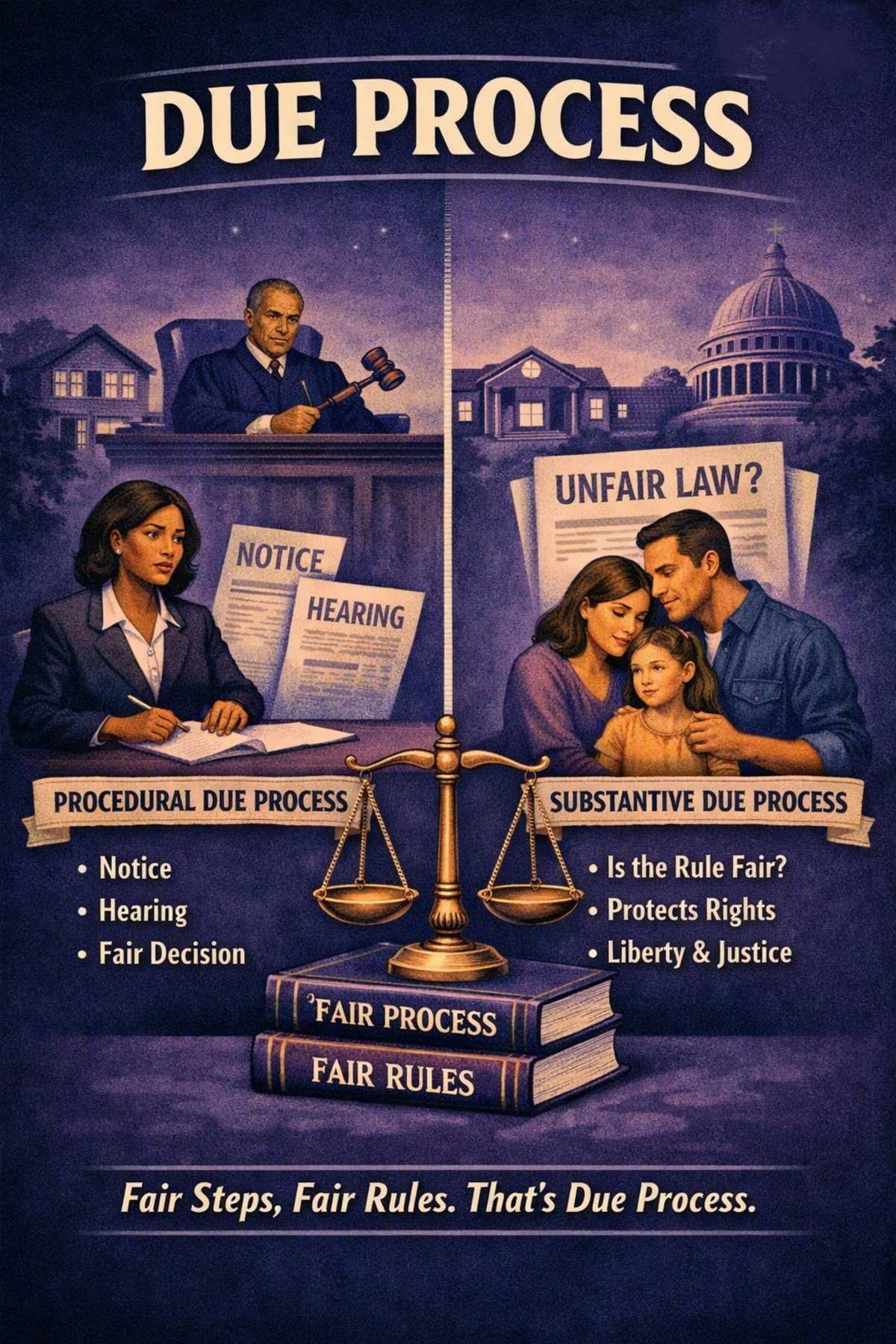
That fairness comes in two forms:
1. Procedural Due Process - the government must follow fair steps.
2. Substantive Due Process - the government's rule must make sense.
These two doctrines control how the government enforces actions in every area of life:
- jobs
- housing
- criminal justice
- family rights
- property
- benefits
- personal liberty
Not just speech.
1. Procedural Due Process - How the government acts:
Before the government takes something from you — your freedom, your home, your job, your benefits — it must:
- Tell you what's happening (notice)
- Let you respond (hearing)
- Have someone neutral decide (impartial decision-maker)
Example: A tenured public-school teacher
Ms. Vox is a tenured teacher in a public school district. The district accuses her of violating professional conduct rules and decided to terminate her employment.
Now let us first break down why a tenured teacher has legally protected property interest in their job.
A tenured public-school teacher has:
- a contract
- legal protection
- and rules that say they can only be fired for cause.
This legal right is the "property interest."
Imagine:
Ms. Vox has taught for 12 years.
- She has earned tenure.
Her contract says she cannot be fired unless the school shows:
- a real reason,
- evidence,
- and gives her a chance to respond.
That job —with those protections — is hers in the eyes of the law.
It's not a gift.
It's not optional.
It's not something the school can take away at whim.
It is a protected interest, just like owning a home or receiving earned benefits.
The Constitution protects this interest. The 14th Amendment says the government cannot take away life, liberty, or property without due process.
For a tenured teacher:
- The job = property
- Firing = taking property
- Due process = the school must play fair
So, before the school can fire Ms. Vox, it must:
1. Tell her what she's accused of (notice)
2. Let her explain (hearing)
3. Have someone neutral decide (fair decision-maker)
If the school skips any of these steps, it violates the Constitution.
A tenured teacher has a property interest in their job because the law says they can't be fired without a fair reason and a fair process. This is 'property interest.' Notice I did not generalize all teachers. This is not automatic for all government jobs.
2. Substantive Due Process
Even if the government follows all the right steps, the rule itself cannot be:
- unreasonable
- random
- oppressive
- cruel
- or destructive of basic liberties
Substantive Due Process protects the deep rights that define being human:
- family
- bodily autonomy
- parenting
- marriage
- privacy
- basic personal choices
Imagine:
A city passes a law banning parents from teaching their children any language except English:
- Parents get notice.
- Parents get a hearing.
- But the rule itself is nonsense — it invades family life and personal freedom.
Substantive Due Process steps in and says:
"Even if your process is fair, your rule is not."
Both doctrines matter because:
Procedural Due Process protects the fairness of the steps. Whereas Substantive Due Process protects the fairness of the rule.
Together, they prevent the government from:
- taking your rights unfairly,
- enforcing laws secretly,
- or creating laws that make no sense.
Procedural Due Process asks: "Did they treat you fairly?"
Substantive Due Process asks: "Was the rule itself fair?"