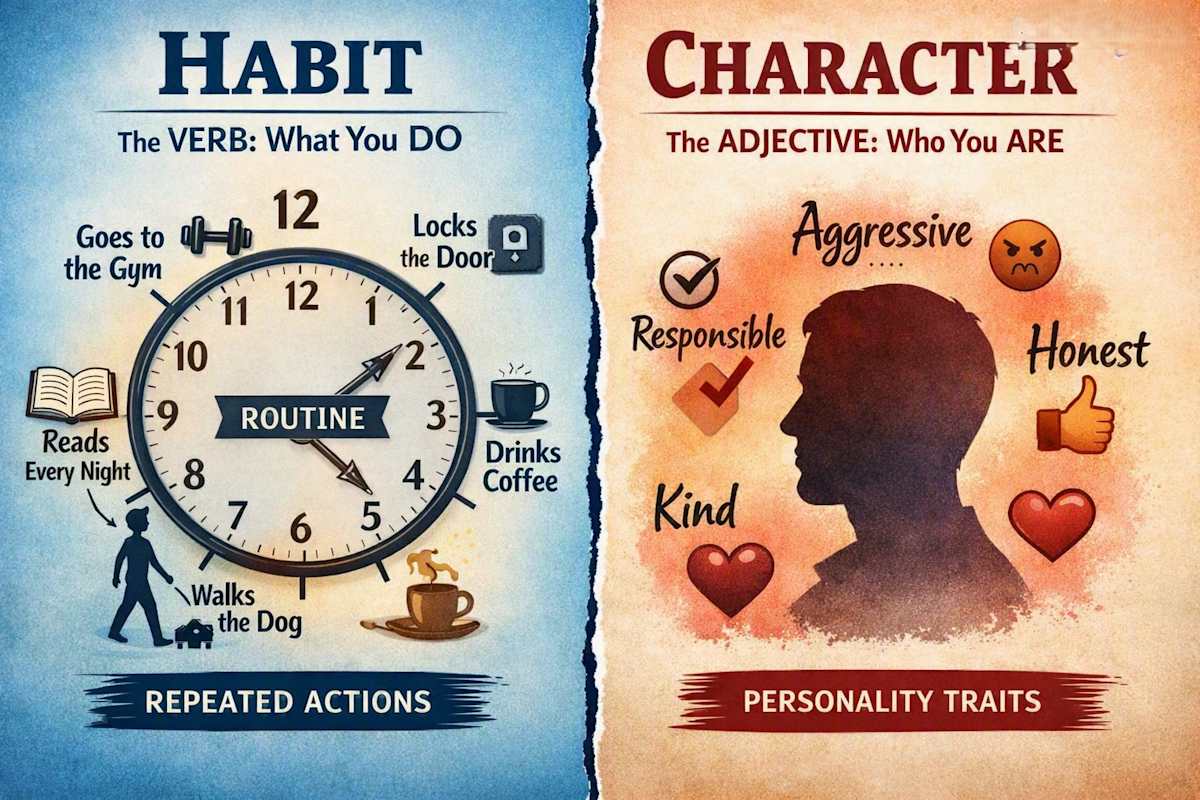
Habit versus Character
The oak tree was calm today. No police reports. No dramatic voicemails. Just the four best friends sitting in their usual circle, iced coffees in hand, ready for Maya's next evidence lesson.
Trevor stretched out on the grass.
"Okay Maya... today you said we're doing Habit and Character. But I swear I never understand the difference."
Maya smiled, pulling out her notebook.
"That's because textbooks explain it like robots. But we're going to explain it like humans."
Lena clapped. "Finally."
Maya drew a big circle — a clock.
THE GOSSIP: Marcus' Clock of Habit
Maya pointed at the clock.
"Habit is a verb. It's something you DO. Over and over. Predictably. Like a routine."
Trevor nodded. "Like how Marcus goes to the gym every morning at 6?"
Maya wrote:
- 6 AM - Marcus goes to the gym
- 7 AM - Marcus drinks a protein shake
- 8 AM - Marcus journals for 10 minutes
- 9 AM - Marcus walks his dog
"That," Maya said, "is habit. It's not emotional. It's not dramatic. It's not about who Marcus is. It's about what Marcus does."
Jules smirked. "So, habit is boring."
Maya laughed. "Exactly. Habit is boring. Habit is predictable. Habit is the same thing every day."
Trevor added, "So if someone says Marcus ALWAYS lock his door at night, that's habit?"
Maya nodded. "Yes. Because it's a repeated action."
THE GOSSIP: Marcus' Character
Maya flipped the page.
"Character is an adjective. It describes the person."
She wrote:
- Marcus is aggressive
- Marcus is jealous
- Marcus is kind
- Marcus is careless
- Marcus is hotheaded
Lena raised her eyebrows. "So, when Talia said, 'He gets angry easily' that's character?"
Maya nodded.
"Character is about personality. Traits. Who someone is, not what they do."
Trevor frowned. "But why does the law care?"
Maya leaned in.
"Because character is dangerous. It makes juries judge people based on personality instead of facts."
Jules nodded. "So, character is usually NOT allowed."
Maya smiled. "Exactly. Habit is allowed. Character is usually banned."
MAYA'S NOTEBOOK: Habit vs. Character
Maya drew two boxes.
HABIT = VERB
Something you DO over and over.
Predictable. Routine.
Example: "Marcus always locks his door."
CHARACTER = ADJECTIVE
Something that DESCRIBES you.
Personality. Traits.
Example: "Marcus is careless."
She circled the HABIT box.
"The law LOVES habit because it's reliable."
She crossed out the Character box.
"The law HATES character because it makes juries emotional."
Doctrine:
Habit is repeated action (verb). Character is a personality trait (adjective).
Habit is admissible.
Character usually isn't. But sometimes the law says: bring the adjectives in."
1. Character of the Accused (Criminal Cases)
When the defendant opens the door.
Maya explains:
"If Marcus were on trial for assault, he could say:
'I'm a peaceful person.'
That's character evidence."
Trevor squints. "But I thought character wasn't allowed."
Maya nods.
"Normally it isn't. But if Marcus brings up his good character first, the prosecution can respond with evidence of his bad character."
Lena laughs.
"So, if he says he's peaceful, they can show he's actually a hothead?"
Maya smiles.
"Exactly. He opened the door."
Rule:
- Defendant can offer evidence of their own good character.
- Prosecution can rebut with evidence of bad character.
2. Character of the Victim (Criminal Cases)
When the defendant claims the victim acted a certain way.
Maya writes:
"If Marcus says, 'Talia is violent,' he's using her character to defend himself."
Trevor raises an eyebrow.
"That sounds messy."
Maya nods.
"It is. But the law allows it in limited situations — like self-defense."
Rule:
- Defendant can offer evidence of the victim's character (e.g., violent).
- Prosecution can rebut with evidence of the victim's peacefulness.
- And they can also attack the defendant's character.
Lena laughs.
"So, accusing the victim can backfire."
3. Character for Truthfulness (Witnesses)
When honesty is on trial.
Maya draws a little stick figure with a speech bubble.
"This one is HUGE. If someone testifies — like Trevor — his honesty becomes relevant."
Trevor gasps.
"My honesty?"
Maya nods.
"If someone says Trevor is a liar, Trevor can bring evidence that he's truthful.
If someone says Trevor is super honest, the other side can attack that."
Rule:
- You can attack or support a witness' character for truthfulness.
- ONLY truthfulness.
- Not kindness, jealousy, anger, or gym habits.
Jules smirks.
"So, this is the only time character becomes a courtroom personality test."
SPECIFIC ACTS vs. REPUTATION vs. OPINION
Maya adds:
"Character can be shown in three ways."
- Reputation: "Everyone knows Marcus is hotheaded."
- Opinion: "I think Marcus is hotheaded."
- Specific Acts: "Marcus punched a wall last week." (Usually not allowed unless it's truthfulness."
Trevor nods.
"So, adjectives are allowed sometimes... but verbs are still safer.
Maya smiles.
"Exactly."
Character is usually banned, but it becomes admissible when:
(1) the defendant brings up their own character,
(2) the defendant attacks the victim's character, or
(3) a witness' honesty is being challenged.