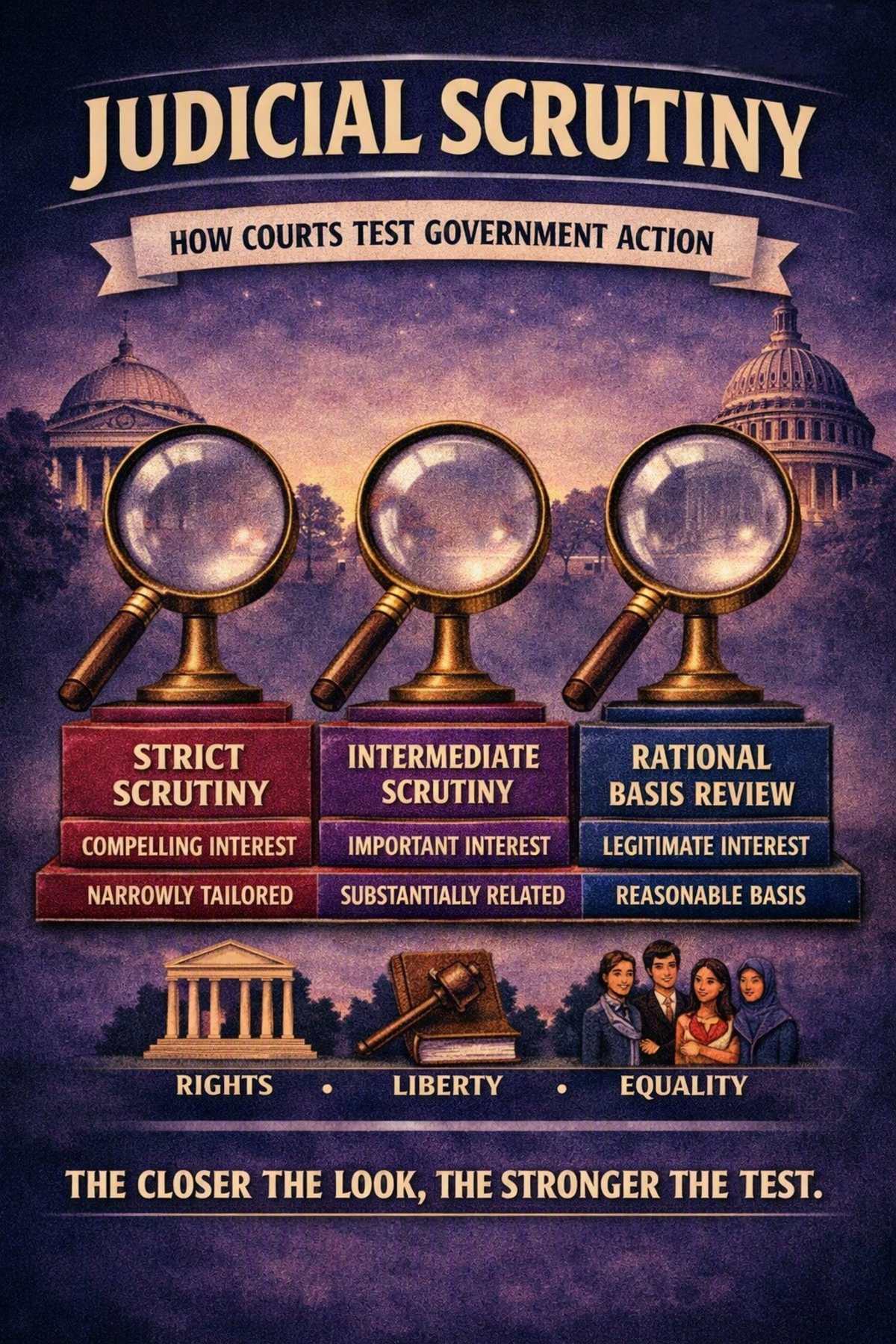
Judicial Scrutiny is the court's fairness test.
Whenever the government:
- passes a law,
- enforces a rule,
- restricts a right,
- treats groups differently,
- or touches liberty in any way.
The court ask:
"How closely should we look at this?"
This level of scrutiny is called Judicial Scrutiny.
It applies across:
- Equal Protection
- Due Process
- Fundamental Rights
- First Amendment
- Privacy
- Voting
- Marriage
- Education
- Criminal Procedure
- Economic Regulation
The Three Levels of Judicial Scrutiny
1. Strict Scrutiny
The highest level — the government almost always loses.
Used when:
- fundamental rights are restricted
- race or national origin classifications
- laws burdening religion
- laws affecting voting
- laws affecting marriage
- laws restricting political speech
Government must prove:
- a compelling reason
- the rule is narrowly tailored
- no less restrictive alternative exists
Example:
A city bans interracial marriage.
The court uses strict scrutiny — and the law instantly collapses.
2. Intermediate Scrutiny
Middle level — the government must justify itself.
Used when:
- gender classifications
- legitimacy classifications
- some commercial speech regulations
Government must prove:
- an important reason
- the rule is substantially related to that reason
Example:
A state gives maternity leave but not paternity leave.
The court ask: "Is this based on stereotypes or real needs?"
3. Rational Basis Review
Lowest Level — the government usually wins.
Used when:
- economic regulations
- social welfare laws
- age classifications
- wealth classifications
- occupation-based rules
- general public policy
Government must prove:
- a legitimate reason
- the rule is reasonably related to that reason
Example:
A city gives senior discounts at the library.
Reasonable. Constitutional.
Think of Judicial Scrutiny as the court's magnifying glass. The more sensitive the right or classification, the stronger the magnifier.
It is the fairness test that protects:
- liberty,
- equality,
- dignity,
- and justice across the entire Constitution.