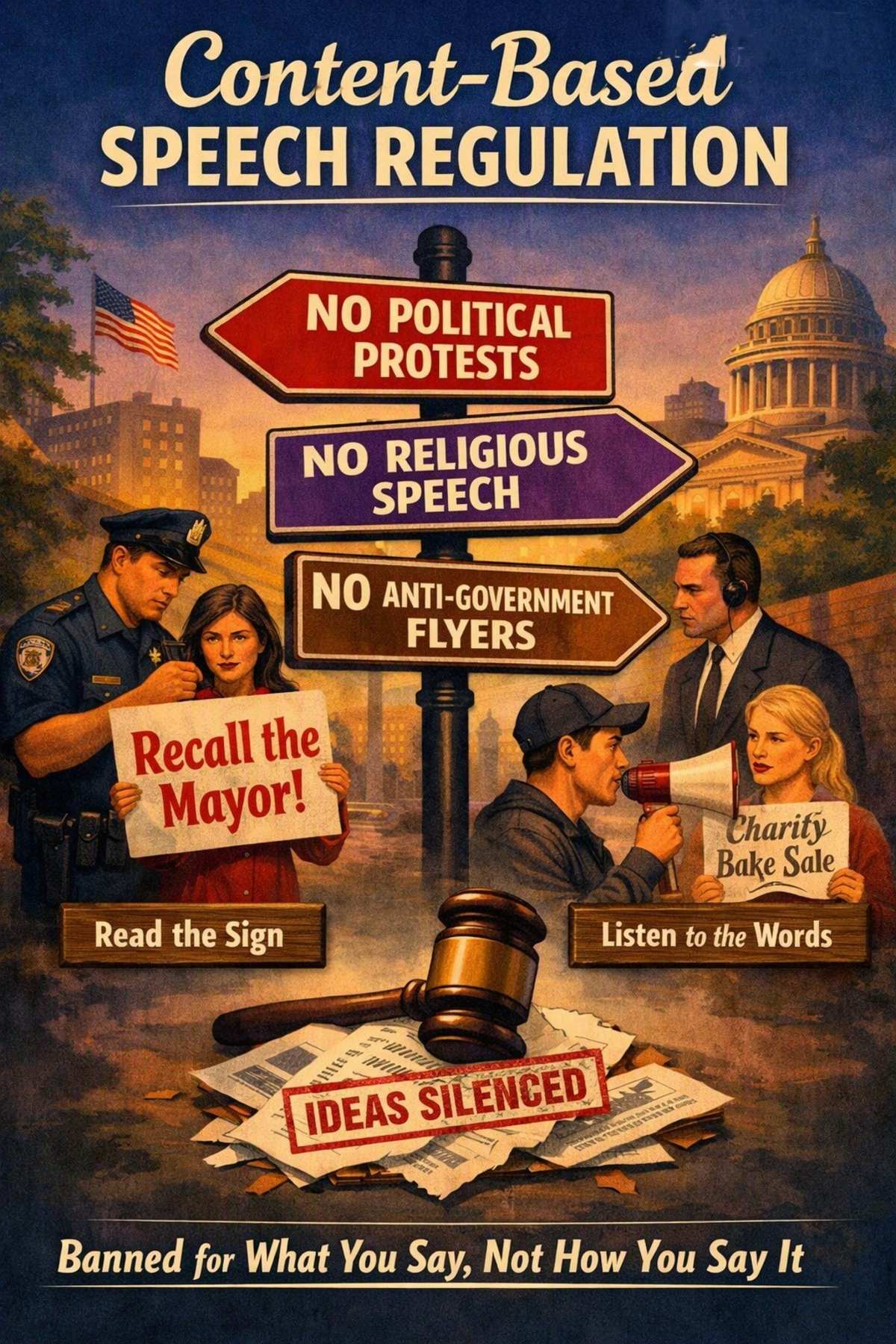
A rule is content-based when the government has to pay attention to your message to decide whether you're breaking the law. If someone must read your sign, listen to your words, or judge your idea to enforce the rule, the rule is content-based.
This is it, no jargon, no complexity. Just this:
If the rule cares about what you're saying, it's content-based.
Examples:
Example 1: The yard sign rule
A city says: "No signs criticizing city officials."
Imagine three neighbors on the same street:
- One puts up a sign that says, "Garage Sale Saturday!"
- Another puts up a sign that says, "Happy Birthday Mum!"
- The third puts up a sign that says, "The mayor is ignoring our neighborhood!"
Only one of these signs gets removed — the one with the critical message.
Not because it's too big.
Not because it's blocking traffic.
Not because it's unsafe.
But because of what the sign says.
This is content-based.
The Constitution cares because: If the government can remove your sign because it doesn't like your message, it can silence any idea it finds uncomfortable, inconvenient, or embarrassing.
The First Amendment exist to protect such from happening.
Example 2: The Flyer
A city says: "No religious flyers."
Imagine there are three flyers on the post office board:
- A flyer for yoga classes.
- A flyer for a neighborhood potluck.
- A flyer for a church youth event
Only one of these signs gets removed — the church flyer.
Not because it's too big.
Not because it's blocking anything.
Not because it's offensive.
But because of its subject matter.
The Constitution cares because: If the government can remove your flyer because it does not like the topic, it can quietly erase entire categories of speech — religion, politics, social issues, anything uncomfortable.
Example 3: The Protest
A city says: "No political protests in the park."
Imagine a park on a Saturday afternoon:
- A group singing for a charity.
- A group advertising a local business.
- A group protesting rising rent prices.
Only the protest group was told to leave.
Not because they're louder.
Not because they're blocking anyone.
Not because they're unsafe.
But because their message was political.
The Constitution cares because: If the government can push political messages out of public space, it can shape public opinion by silencing one side.
If the government decides if your message is allowed to be conveyed or not, then it is content-based.
Content-Based triggers Strict Scrutiny
Strict Scrutiny means two things:
1. The government must have an extraordinary reason.
Not a good reason.
Not a strong reason.
Not a "this makes life easier" reason.
A rate, exceptional, life-or-death level reason — the kind of reason that makes everyone stop and say, "okay...that actually matters."
Examples of extraordinary reasons:
- Preventing imminent violence.
- Protecting national security.
- Stopping a genuine emergency.
Not:
- avoiding discomfort
- preventing criticism
- keeping officials from being embarrassed
- making public spaces "less political"
2. The rule must be precise.
It cannot be:
It cannot be broad.
It cannot be vague.
It cannot sweep in more speech than absolutely necessary.
It must be:
- narrow
- specific
- targeted
- and only big as the emergency requires
If the rule is a little too wide, it fails.