The Principle:
Every First Amendment question begins with a single dividing line: Is the government regulating the message, or the mechanics of delivering it?
Imagine:
A city rule banning all amplified sound after 10 p.m. It doesn't care whether you're singing gospel, protesting a policy, or advertising a sale — it only cares about the volume. Across town, another ordinance bans "political message" on public signs. That rule requires the government to read the sign, judge the message, and decide whether it is allowed. One regulates noise; the other regulates ideas.
Putting the Pieces Together:
Content-Neutral
Sometimes the government isn't trying to silence your message — it's just trying to keep life running smoothly.
Think of it like this:
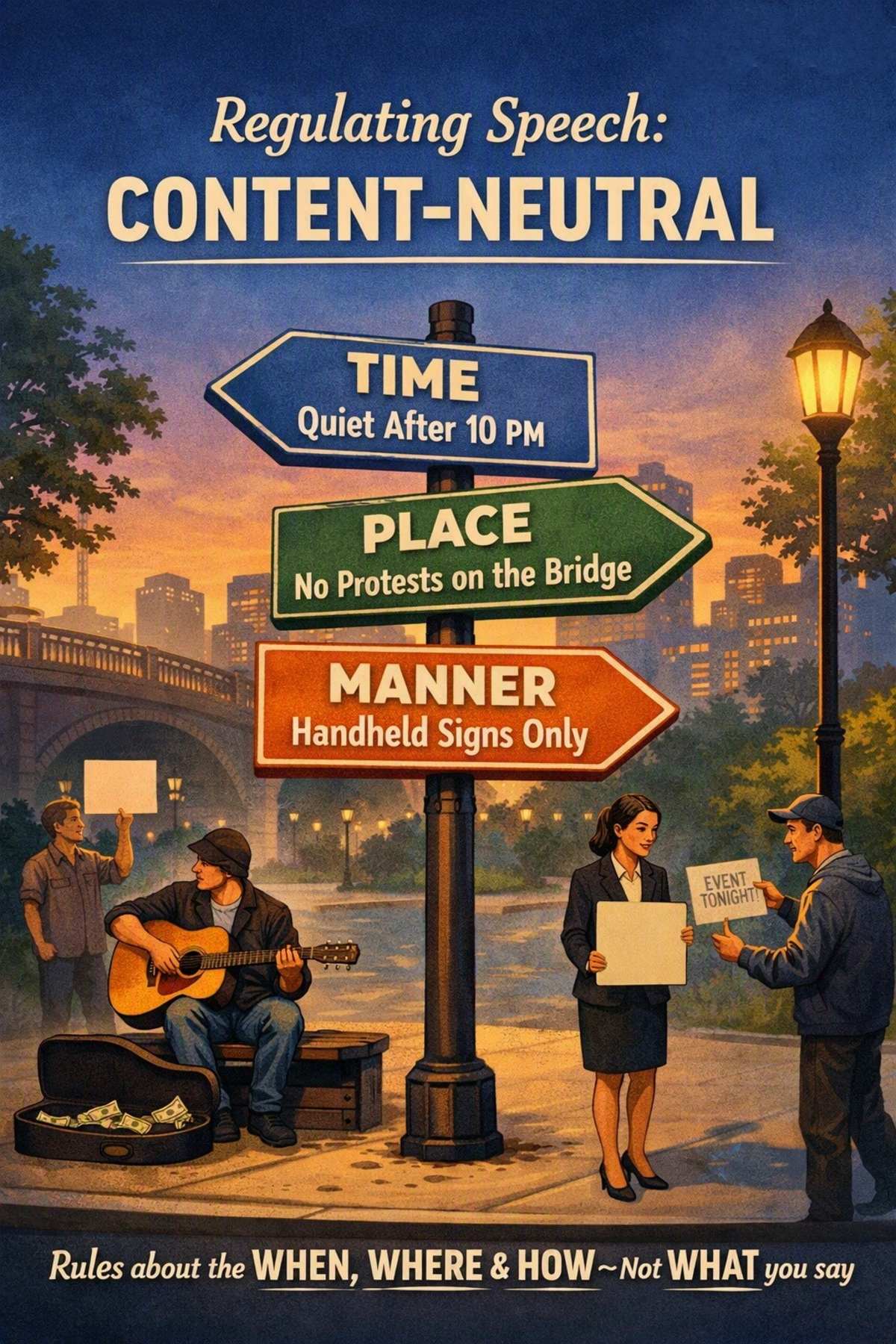
- Time: You can speak — just not at 3 a.m. with a megaphone.
- Place: You can protest — just not in the middle of the highway.
- Manner: You can hand out flyers — just not by blocking the building entrance.
These rules don't care about what you are saying. They care about noise, safety, and order. This is what "content-nuetral" really means: The rule applies the same way no matter what the message is.
Content-Neutral triggers Intermediate Scrutiny. The government must have a good reason, and it can't shut down speech completely. Under Intermediate Scrutiny the government must have a real, practical reason — and the rule must leave people other ways to speak.
What it really means for a rule to "leave people other ways to speak."
Think of speech like water. If the government blocks one path, the Constitution requires that the water can still flow somewhere else. Meaning, simply the government can't shut the door and walk away.
If a city says:
"You can't use a megaphone here," it must still allow you to speak in another way —talking, handing out flyers, holding a sign, speaking at a different time, or moving a few feet over.
It means the rule can't trap your voice.
A rule is unconstitutional if it leaves you no realistic way to express yourself.
It means the government can't silence you by inconvenience.
If the only "alternative" is:
- speaking in a place no one goes,
- at a time, no one is awake,
- or in a manner no one can hear,
that's not an alternative — that's a quiet shutdown.
It means your message must still be able to reach people.
The Constitution doesn't require the government to give you microphone. But it does require the government to avoid rules that make your speech pointless. If the rule leaves you with a way to speak that still lets your message be heard, it's usually okay. If it leaves you with a way to speak that guarantees no one will hear you, it's not.
A rule is only "content-neutral" if it limits how you speak without making it impossible for you to speak at all.